
Plantar Fasciitis Treatment in Plymouth: Can the Right Shoes Help Your Heel Pain?
You get out of bed, put your foot on the floor and…
Ouch.
Those first few steps feel as though your heel has suddenly forgotten how walking works.
After moving around for a while, things may ease. Then you've been sitting at your desk or relaxing on the sofa, stand up again and there it is – that familiar heel pain.
If this sounds familiar, plantar fasciitis could be one possible cause.
And if you've already started looking for solutions, you've probably come across plenty of advice about shoes.
So, can changing your footwear really help plantar fasciitis?
For some people, the right shoes can make an important difference – but footwear is only one part of the picture.
At Derriford Therapies in Plymouth, our HCPC-registered podiatrists can assess your heel pain, look at what may be contributing to it and help you understand the most appropriate treatment options.
What is plantar fasciitis?
The plantar fascia is a strong band of tissue running along the bottom of your foot, from your heel towards your toes.
It helps support your foot when you stand, walk and move.
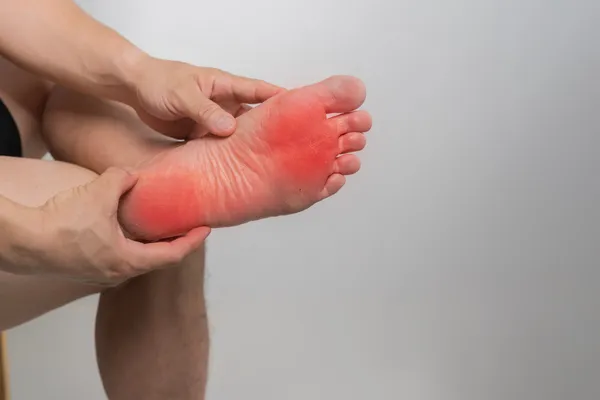
When this tissue becomes irritated or overloaded, you can develop pain around the heel and underneath the foot.
This is commonly called plantar fasciitis.
One of the classic symptoms is heel pain during your first few steps after getting out of bed.
You may also notice pain:
When standing after sitting for a while
After spending a long time on your feet
Following an increase in walking or exercise
Around the bottom or inside of the heel
After activity rather than necessarily during it
However, not every painful heel is caused by plantar fasciitis.
That's an important point.
Why do shoes matter when you have heel pain?
Think about how much time your feet spend inside shoes.
For many of us, it's most of the day.
Every time you stand or walk, your footwear affects how your feet interact with the ground.
Shoes can influence:
How stable your feet feel
How much cushioning there is beneath your heel
How pressure is spread across the foot
How your foot moves inside the shoe
How comfortable you feel when walking
If your footwear is worn out, poorly fitting or unsuitable for the activity you're doing, it may contribute to discomfort.
Changing footwear doesn't automatically cure plantar fasciitis, but wearing appropriate shoes can form an important part of managing heel pain.
What should I look for in shoes for plantar fasciitis?
There isn't one perfect "plantar fasciitis shoe" that suits everybody.
Your feet, activities and symptoms are individual.
However, there are several features worth considering.
1. A secure fit
Your shoe should hold your foot comfortably without squeezing it.
If your foot is sliding around inside the shoe with every step, your muscles and other structures may have to work harder to control that movement.
Laces, straps or other secure fastenings can help keep the shoe comfortably attached to your foot.
A shoe should feel like it's coming with you.
Not like you're trying to keep it on through sheer determination.
2. Enough room for your toes
Your toes shouldn't be squeezed together.
Look for a shoe with enough width and depth around the front so your toes can sit comfortably.
This is particularly important if you also have bunions, corns, painful nails or areas of pressure.
Your toes need somewhere to live.
Give them the floor space.
3. Suitable cushioning
Some people with heel pain find additional cushioning comfortable.
A shoe with suitable cushioning can help reduce the sensation of repeated impact when walking on hard surfaces.
However, more cushioning isn't automatically better.
A shoe can feel wonderfully soft when you first put it on but provide very little stability when you start walking.
Comfort and support need to work together.
4. A stable sole
Pick up your shoe and give it a gentle twist.
If it folds and twists in every direction with almost no resistance, it may not provide the level of stability you need.
For some people with plantar fasciitis, a more stable shoe can feel more comfortable.
That doesn't mean your footwear needs to be completely rigid.
The aim is to find something appropriate for your foot and activity.
5. The right shoe for what you're doing
Your footwear should match your activity.
The shoes you wear for a gentle trip to the shops may not be the best choice for a long walk.
Likewise, old trainers that have covered hundreds of miles may no longer perform as they did when you bought them.
Look at the shoes you spend the most time wearing.
Sometimes the pair causing the most trouble isn't the obvious one.
Are flat shoes bad for plantar fasciitis?
Not automatically.
The problem with simply saying "flat shoes are bad" is that not all flat shoes are the same.
A secure, well-fitting trainer is very different from a thin, unsupportive slip-on shoe, even if both have relatively low heels.
Rather than focusing only on heel height, consider the whole shoe:
Does it fit properly?
Does it stay securely on your foot?
Is there suitable cushioning?
Does it feel stable?
Is it appropriate for what you're doing?
Your podiatrist can also assess your usual footwear and explain which features may be useful for you.
What about walking barefoot?
Some people with plantar fasciitis find walking barefoot around the house uncomfortable, particularly on hard floors.
You may notice that your heel feels much happier inside supportive footwear than it does walking around the kitchen barefoot.
If that's the case, comfortable indoor footwear may be worth considering while your symptoms are irritated.
However, everybody is different.
Your treatment plan should be based on your symptoms rather than a blanket rule that everyone must wear shoes every waking minute.
Should I buy expensive trainers?
Not necessarily.
An expensive shoe isn't automatically the right shoe.
And a shoe covered in impressive technical language doesn't necessarily mean your heel will love it.
Fit, comfort and suitability matter more than the price tag.
If possible, try shoes on before buying them.
Walk around.
Don't just stand in front of the mirror and decide they feel fine after eight seconds.
Your feet are going to spend hours in them, so give them a proper test.
Should I buy shoes a size bigger?
Buying a larger size isn't always the answer.
Shoe sizing can vary between manufacturers, and width and shape are just as important as the number printed inside.
A shoe that's too small can squeeze your toes.
But a shoe that's too large may allow your foot to move around excessively.
Aim for a comfortable fit with enough room around the toes while still holding the foot securely.
Can insoles help plantar fasciitis?
For some people, yes.
An insole or orthotic can sometimes be used to change how pressure and forces act through the foot.
But not everybody with plantar fasciitis automatically needs orthotics.
Depending on your assessment, you may benefit from:
Footwear changes
Suitable exercises
Changes to activity
Advice about managing load on the foot
Insoles or orthotics
A combination of different approaches
At Derriford Therapies, we prefer to assess first and recommend afterwards.
Your painful heel doesn't automatically need an expensive object placed underneath it.
What about heel cushions?
A cushioned heel insert may feel comfortable for some people.
But simply putting something soft underneath the painful area doesn't necessarily address everything contributing to the problem.
There's also a practical issue.
Adding an insert changes how your foot fits inside the shoe.
If the shoe is already tight, adding more material may create pressure elsewhere or cause your heel to sit too high.
That's why footwear and insoles need to be considered together.
Should I replace my old trainers?
Possibly.
Shoes don't last forever.
Even when the outside still looks reasonably respectable, the materials inside and underneath can gradually wear down.
Think about:
How long you've owned them
How frequently you wear them
How much walking or running they've done
Whether the sole is noticeably worn
Whether one side is wearing differently
Whether they feel less comfortable than they used to
If your trainers have been with you through several years, countless walks and possibly a house move, they may have earned their retirement.
What else can help plantar fasciitis?
Footwear is only one part of managing heel pain.
Depending on your individual situation, your podiatrist may also discuss:
Specific stretching or strengthening exercises
Temporary changes to activity
Gradually managing your return to exercise
Orthotics or insoles where appropriate
Your work and daily routine
Other treatment options based on your assessment
The important thing is to understand why your heel is hurting and what may be contributing to it.
There isn't one solution that works for every person.
Should I stop exercising?
Not necessarily.
Stopping everything isn't always required, but continuing to repeatedly aggravate a painful heel may not be helpful either.
You may need to temporarily change the type, duration or intensity of your activity.
For example, someone who has suddenly increased their walking or running may need a different plan from someone who stands for long periods at work.
A podiatrist can help you make sensible adjustments without automatically telling you to stop doing everything you enjoy.
When should I see a podiatrist about heel pain?
Consider booking a podiatry assessment if:
Your heel pain keeps returning
Your first steps in the morning are regularly painful
The pain has lasted for several weeks
You're changing the way you walk
Pain is stopping you exercising or walking comfortably
You've changed shoes without improvement
You've tried insoles but aren't sure they're helping
Your symptoms are getting worse
You're not sure whether you actually have plantar fasciitis
You don't need to wait until walking becomes unbearable before seeking professional advice.
Not all heel pain is plantar fasciitis
This is worth repeating.
Heel pain does not automatically mean plantar fasciitis.
There are several possible causes of pain around the heel and foot.
Trying to treat yourself based solely on where it hurts can sometimes mean treating the wrong problem.
A podiatry assessment can help identify what may be causing your symptoms and whether plantar fasciitis is actually the likely explanation.
How Derriford Therapies can help with plantar fasciitis in Plymouth
At Derriford Therapies in Plymouth, our HCPC-registered podiatrists can assess your heel pain and look at the bigger picture.
We'll talk about when your pain started, when it hurts most, your normal activities and what you've already tried.
We can also assess your feet and lower limbs and discuss the footwear you regularly use.
If your shoes could be contributing to the problem, we'll explain what features may suit your feet better.
If orthotics could help, we'll discuss why.
And if we don't think you need them, we'll tell you that too.
Our aim is to give you honest, understandable advice based on your individual feet.
Don't let heel pain choose your shoes – or your activities
Heel pain can gradually start making decisions for you.
You stop taking longer walks.
You avoid standing for too long.
You choose activities based on whether there will be somewhere to sit down.
And you develop an increasingly impressive collection of shoes and insoles that promised to solve everything.
If heel pain is starting to affect your everyday life, it's worth finding out what's actually happening.
If you're looking for plantar fasciitis treatment in Plymouth, our friendly team at Derriford Therapies can assess your feet and discuss the most appropriate next steps.
Book your podiatry appointment online or give our reception team a call. Your feet may simply need the right support to get moving comfortably again.
Important Medical Disclaimer
The information in this blog is provided for general education and information only. It should not be taken as individual medical advice, diagnosis or treatment, and it is not a substitute for an assessment by a qualified healthcare professional.
There are several possible causes of heel pain, and plantar fasciitis cannot be diagnosed from symptoms alone.
If you have persistent, worsening or unexplained heel or foot pain, please seek advice from a podiatrist, general practitioner or another appropriate healthcare professional.
Seek prompt medical advice for sudden or severe pain, significant swelling, redness or heat, an injury that prevents you from comfortably putting weight through your foot, or any other symptoms that concern you.