Verruca or Corn? How to Tell the Difference
You've found a small, hard, uncomfortable patch on the bottom of your foot.
So what is it?
A corn? A verruca? Something else entirely?
It's a surprisingly common question. Verrucas and corns can look similar, particularly when they're covered by hard skin. Both can appear on pressure-bearing areas of the foot and both can become uncomfortable when you're walking.
But they're very different problems.
One is caused by pressure and friction. The other is caused by a virus.
Knowing the difference matters because the treatment for a corn isn't the same as the treatment for a verruca.
Let's take a closer look.
What is a corn?
A corn is a small, concentrated area of thickened skin.
Corns usually develop because an area of your foot is repeatedly exposed to pressure or friction.
Your skin is actually trying to protect itself.
If one small area keeps experiencing extra pressure, the skin can become thicker and harder. Eventually, a dense area of hard skin may develop.
Common places for corns include:
Underneath the ball of the foot
On the tops of the toes
Between the toes
Around prominent joints
Areas where footwear repeatedly rubs
Corns can be surprisingly painful for something so small.
People sometimes describe the feeling as having a tiny stone permanently stuck inside their shoe.
What is a verruca?
A verruca is a wart that develops on the foot.
It's caused by certain types of the human papillomavirus, usually shortened to HPV.
The virus enters the outer layers of the skin, often through tiny breaks that you may not even notice.
Because verrucas commonly develop on the sole of the foot, pressure from standing and walking can push them inwards. This can make them look flatter than warts found elsewhere on the body.
Hard skin can also develop over the top.
And that's where the confusion begins.
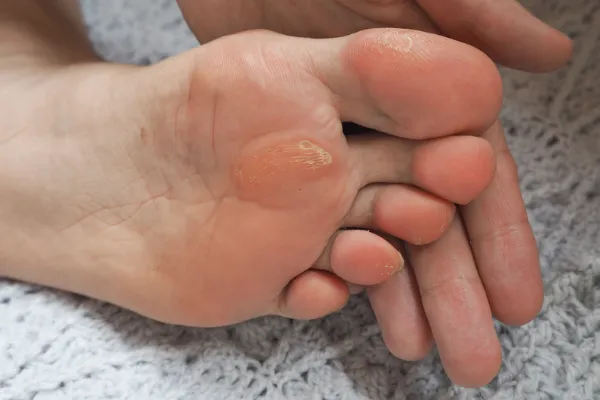
At first glance, that little hard patch could look very much like a corn.
Verruca vs corn: what are the main differences?
There are a few clues a podiatrist may consider when assessing the area.
However, it's worth saying clearly:
Trying to diagnose a foot problem yourself isn't always straightforward.
Corns, verrucas and other skin problems don't necessarily read the textbook before appearing on your foot.
If you're unsure, getting it checked is much safer than repeatedly treating the wrong thing.
Corns are caused by pressure
A corn usually develops where repeated pressure or friction is occurring.
That may be linked to:
Tight or poorly fitting footwear
Toe position
Prominent joints
Foot shape
The way pressure travels through your foot
A verruca, on the other hand, is caused by a viral infection.
That's one of the biggest differences.
What does a corn look like?
A corn may appear as a small, well-defined area of hard or thickened skin.
There can be a denser central area, sometimes described as a core.
Depending on where it develops, the surrounding skin may also be thickened.
Pressure directly over the corn can be painful.
If you have one underneath your foot, you may notice the discomfort most when standing or walking.
But appearances alone aren't always enough to make a reliable diagnosis.
What does a verruca look like?
Verrucas can vary considerably in appearance.
They may look rough or uneven and can sometimes be surrounded or covered by hard skin.
You may notice tiny dark dots within the lesion. These can be small blood vessels rather than a “root”, despite the common myth that verrucas have roots.
The normal lines or ridges of the skin may also appear disrupted around a verruca.
Sometimes several verrucas develop close together, forming a larger affected area.
Again, not every verruca looks exactly the same.
Does a corn hurt differently from a verruca?
You may have heard that you can identify them by squeezing the area in a particular direction.
While the pattern of tenderness can sometimes provide a clue, pain alone isn't a reliable home diagnostic test.
Both corns and verrucas can hurt.
Both can become uncomfortable when you're walking.
Both can be surrounded by hard skin.
A podiatrist can assess the appearance, location and characteristics of the lesion properly rather than relying on one simple test.
Can corns spread?
Corns are not contagious.
You can't catch a corn from somebody else.
However, if the pressure causing the corn continues, it may return even after the hard skin has been treated.
That's why simply removing the painful skin isn't always the whole answer.
We also need to ask:
Why is that area getting so much pressure?
Changing footwear, reducing pressure or using appropriate padding may sometimes help prevent the problem from repeatedly returning.
Can verrucas spread?
Yes.
Because verrucas are caused by a virus, they can spread.
The virus can pass through direct contact or potentially through contaminated surfaces, particularly where people are barefoot.
Communal changing areas, swimming pools and showers are often associated with verrucas because the environment can make transmission easier.
If you have a verruca, avoid picking, scratching or cutting it.
Doing so may irritate the skin and potentially encourage the virus to spread to nearby areas.
It's also sensible not to share items such as socks, shoes or towels.
Should I cut out a corn myself?
Please don't.
It can be tempting, especially when there's an obvious hard area that looks as though it should simply be removed.
Using blades, scissors or other sharp objects on your feet can damage healthy skin and create a risk of infection.
This is particularly important if you have diabetes, poor circulation or reduced sensation in your feet.
A podiatrist can safely remove appropriate areas of hard skin and assess what's causing the pressure.
Should I try to cut out a verruca?
No.
A verruca isn't something that can simply be dug out.
Remember, it's a viral infection affecting the skin.
Cutting or picking at it can cause bleeding, damage healthy tissue and potentially spread the virus.
If you've spent several evenings attacking your foot with bathroom implements while thinking, “I'm sure I've nearly got it”, it's time to put the tools down.
Your foot will appreciate it.
Can verrucas disappear without treatment?
Some verrucas do clear without treatment as the immune system responds to the virus.
How long this takes varies considerably.
For some people, the verruca may cause very little trouble and eventually disappear.
For others, it can remain for a long time, become uncomfortable or spread.
Treatment may be considered when a verruca is persistent, painful, spreading or simply becoming troublesome.
What happens if I treat a corn as a verruca?
This is one reason why getting the diagnosis right matters.
Over-the-counter verruca treatments often contain ingredients designed to break down affected skin.
Using them on something that isn't actually a verruca can irritate or damage healthy tissue.
Similarly, repeatedly filing or cutting an area you assume is a corn isn't a good idea if you don't know what you're dealing with.
If a lesion isn't behaving as expected or you're uncertain what it is, have it professionally assessed.
How does a podiatrist tell the difference?
A podiatrist can examine the lesion closely and consider factors including:
Its appearance
Where it is located
The surrounding skin
The pattern of skin lines
How pressure affects it
Whether small blood vessels are visible
Whether hard skin is covering the area
Your symptoms and how long you've had them
Sometimes removing a small amount of overlying hard skin professionally can also make the underlying structure easier to assess.
The important part is establishing what you're dealing with before deciding how to treat it.
How are corns treated?
If you have a corn, treatment may involve carefully reducing the thickened skin to relieve discomfort.
But we don't want to stop there.
If the pressure remains exactly the same, there's a good chance the corn will return.
Depending on the cause, we may also discuss:
Footwear
Pressure relief
Padding
Foot shape
Toe position
Orthotic therapy where appropriate
The aim is not simply to make the corn disappear temporarily. It's also to understand why it developed.
How are verrucas treated?
Verruca treatment depends on several factors, including how long the verruca has been present, its size, location and whether previous treatments have been unsuccessful.
At Derriford Therapies, one of the options available for suitable patients is SWIFT verruca treatment.
SWIFT uses controlled microwave energy delivered to the affected area. The aim is to stimulate an immune response to help your body recognise and respond to the infected tissue.
Unlike trying to physically cut away a verruca, the treatment is designed to work with your body's immune response.
Not every person or every skin lesion is automatically suitable for the same treatment, which is why an assessment comes first.
When should I see a podiatrist?
Consider booking an assessment if:
You aren't sure whether you have a corn or verruca
The area is painful
It's affecting your walking
The lesion keeps returning
You think a verruca is spreading
Home treatment hasn't worked
The area has changed unexpectedly
You're worried about what the lesion actually is
If you have diabetes, reduced sensation, circulation problems or another condition that affects your feet, it's particularly important to seek professional advice before using medicated treatments or attempting to remove hard skin yourself.
And if a skin lesion is bleeding unexpectedly, changing significantly or simply doesn't look right, seek appropriate medical advice.
Verruca or corn? Don't guess if you're unsure
The main difference sounds simple:
A corn develops because of pressure or friction. A verruca is caused by a virus.
The tricky part is that they don't always look obviously different when they're sitting underneath a layer of hard skin.
That's why it's very easy to spend weeks treating a “verruca” that isn't a verruca at all.
Or repeatedly removing hard skin from what you think is a corn without addressing the real problem.
Your bathroom cabinet doesn't need to become a miniature foot clinic.
Sometimes the quickest way to know what you're dealing with is simply to let a professional look at it.
Corn and verruca treatment in Plymouth
At Derriford Therapies in Plymouth, our friendly HCPC-registered podiatrists can assess the problem, explain what we find in straightforward language and recommend appropriate treatment.
If it's a corn, we can look at both the painful skin and the pressure contributing to it.
If it's a verruca, we can discuss suitable treatment options, including SWIFT verruca treatment where appropriate.
Our bright, modern clinic offers ground-floor access, easy parking and a friendly reception team ready to help.
Not sure whether that annoying little patch is a verruca or a corn?
Rather than guessing — or attacking it with something from the bathroom cupboard — book a podiatry appointment online or give our reception team a call.