![Non US - Podiatry [SNAPSHOT]](https://images.leadconnectorhq.com/image/f_webp/q_80/r_1200/u_https://assets.cdn.filesafe.space/JmxfbASJamGHvnyGIV0D/media/6a4b8013b10447eb52403dfa.png )
Tips & Advice From Derriford Therapies
Orthotics in Plymouth: Could Insoles Help Your Foot, Knee or Leg Pain?
If your feet, knees or legs seem to complain every time you go for a walk, stand for too long or get through a busy day, it can be tempting to simply put it down to getting older.
But pain isn't something you should automatically accept.
Sometimes, the problem isn't only where you feel the pain. The way your feet move and support your body can affect your ankles, knees and legs too.
And that's where orthotics may be able to help.
At Derriford Therapies in Plymouth, we often see people who are surprised to discover just how much their feet can influence what happens further up the body.
What are orthotics?
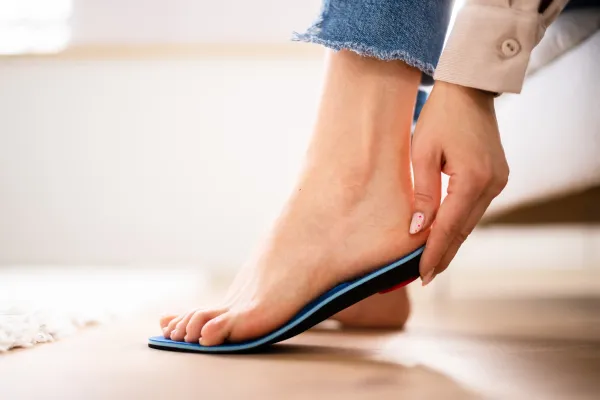
Orthotics are specially designed insoles that sit inside your shoes.
They can be used to change the way pressure is spread across your feet, provide extra support and help your feet work more comfortably when you stand, walk or exercise.
You may have seen rows and rows of insoles in pharmacies, supermarkets and shoe shops.
Some of these can certainly make shoes feel more comfortable. However, an orthotic recommended following a podiatry assessment is different.
The important bit isn't simply putting something inside your shoe. It's understanding why you're experiencing pain in the first place.
Can your feet really cause knee or leg pain?
Your feet are the foundations you stand and walk on.
When you take a step, your feet, ankles, legs, knees and hips all work together. If something isn't moving as comfortably or efficiently as it could, other areas may have to work a little harder.
Imagine walking around with one shoe slightly different from the other. You might adjust how you walk without even noticing.
Over hundreds or thousands of steps, those little changes can sometimes contribute to discomfort.
This doesn't mean that every aching knee is caused by your feet. Far from it.
That's why a proper assessment matters.
Rather than assuming you need orthotics, a podiatrist can look at your symptoms, feet, footwear and the way you move to work out what may be contributing to the problem.
What problems can orthotics help with?
Depending on the cause of your symptoms, orthotics may form part of a treatment plan for problems such as:
Heel pain and plantar fasciitis
Pain around the arch of the foot
Pain in the ball of the foot
Certain types of ankle discomfort
Pressure beneath particular areas of the foot
Some types of knee or lower-leg pain
Foot fatigue when walking or standing
Problems linked to the way your feet move when walking
Orthotics aren't a magic answer to every foot or leg problem.
Sometimes changing your footwear, adjusting your activity, doing suitable exercises or having another form of podiatry treatment may be more appropriate.
The aim is always to find the right treatment for you, rather than simply selling you a pair of insoles.
What about plantar fasciitis?
Plantar fasciitis is one of the common reasons people seek help for heel pain.
The plantar fascia is a strong band of tissue underneath your foot. It runs from your heel towards your toes and helps support the foot.
When it becomes irritated, you may experience pain underneath or around the heel.
A classic complaint is:
"The first few steps out of bed are awful!"
The pain may ease as you start moving, only to return after you've been sitting down or after spending a long time on your feet.
Orthotics can sometimes help by changing the forces going through the foot and reducing strain on painful areas.
However, they are usually only one part of managing plantar fasciitis. Footwear, exercises, activity levels and other factors may also need to be considered.
Shop-bought insoles or orthotics – what's the difference?
A comfortable shop-bought insole isn't automatically a bad thing.
For some people, a simple cushioned insole may provide all the extra comfort they need.
The problem comes when you're buying insole after insole without knowing what you're trying to correct.
One pair promises extra cushioning.
Another promises arch support.
Another looks like it belongs in a running shoe designed for an astronaut.
Before long, there's a small collection gathering dust in the cupboard and your foot still hurts.
If you're experiencing ongoing pain, it makes sense to find out what is causing it before deciding what should go inside your shoes.
Do I need custom orthotics?
Not necessarily.
At Derriford Therapies, our priority is your health and finding an appropriate solution for your problem.
For some people, a relatively simple insole or footwear change may be enough. Other people may benefit from a more individual orthotic prescription.
It depends on your feet, your symptoms, your activities and what we find during your assessment.
We don't believe everybody who walks through the door with foot pain automatically needs orthotics.
Good podiatry starts with assessment, not assumptions.
Your shoes matter too
Even a well-chosen orthotic needs a suitable shoe.
If your footwear is extremely narrow, worn out, unstable or simply doesn't have enough room, putting an orthotic inside may not solve the problem.
In some cases, it can make the shoe feel even tighter.
A podiatrist can look at the shoes you regularly wear and explain what features may help.
That doesn't necessarily mean abandoning every pair of shoes you like and spending the rest of your life in something sensible enough to frighten your wardrobe.
Often, small and realistic changes can make a difference.
When should you see a podiatrist?
Consider booking a podiatry assessment if:
Your foot pain keeps returning
Pain is stopping you walking as much as you'd like
Your heel hurts when you first get out of bed
Your feet become very tired or painful during the day
You're experiencing unexplained knee or lower-leg discomfort
You've already tried different shoes or insoles without success
Your symptoms are getting worse rather than better
You should also seek appropriate medical advice promptly for sudden or severe pain, significant swelling, redness or heat, an injury you cannot comfortably put weight through, or other symptoms that concern you.
How Derriford Therapies can help
At Derriford Therapies in Plymouth, our HCPC-registered podiatrists take the time to understand what's happening rather than simply focusing on the painful spot.
We'll talk to you about your symptoms and daily activities and assess your feet and lower limbs. We can also look at your footwear and how your feet are working when you move.
If orthotics could help, we'll explain why and discuss suitable options with you.
And if we don't think you need them, we'll tell you that too.
We believe patients should have clear, honest information so they can make informed decisions about their treatment.
Don't let painful feet decide what you can do
Foot, knee and leg pain can gradually change your habits.
Perhaps you start avoiding longer walks. You sit down more often. You stop doing an activity you enjoy because you know you'll pay for it afterwards.
Those little compromises can add up.
If you're struggling with ongoing foot, heel, knee or lower-leg pain in Plymouth, a podiatry assessment could help you understand why it's happening and what you can do about it.
Your feet carry you through thousands of steps every day. They deserve a little attention when they start complaining.
If you'd like to find out whether orthotics or another podiatry treatment could help, book an appointment with Derriford Therapies in Plymouth or give our friendly reception team a call.
We'll help you find the right next step for your feet — preferably a more comfortable one.

Ask Derriford Therapies And Their Team
Fill in the form to request a call from our team. One of our team members will call you for FREE and answer any questions or concerns you may have about your condition
Where To Find Derriford Therapies
If you have any questions before scheduling an appointment or for general inquiries, please use the contact us button below. Our team will promptly reach out to assist you.
Opening Hours
Monday: 09.30- 17.30
Tuesday: 09.30- 17.30
Wednesday: 08.30- 17.30
Thursday: 08.30- 17.30
Friday: 08.30- 17.30
Saturday: By appointment only
Sunday: Closed